

I had the opportunity to go to a State Library event the other day.
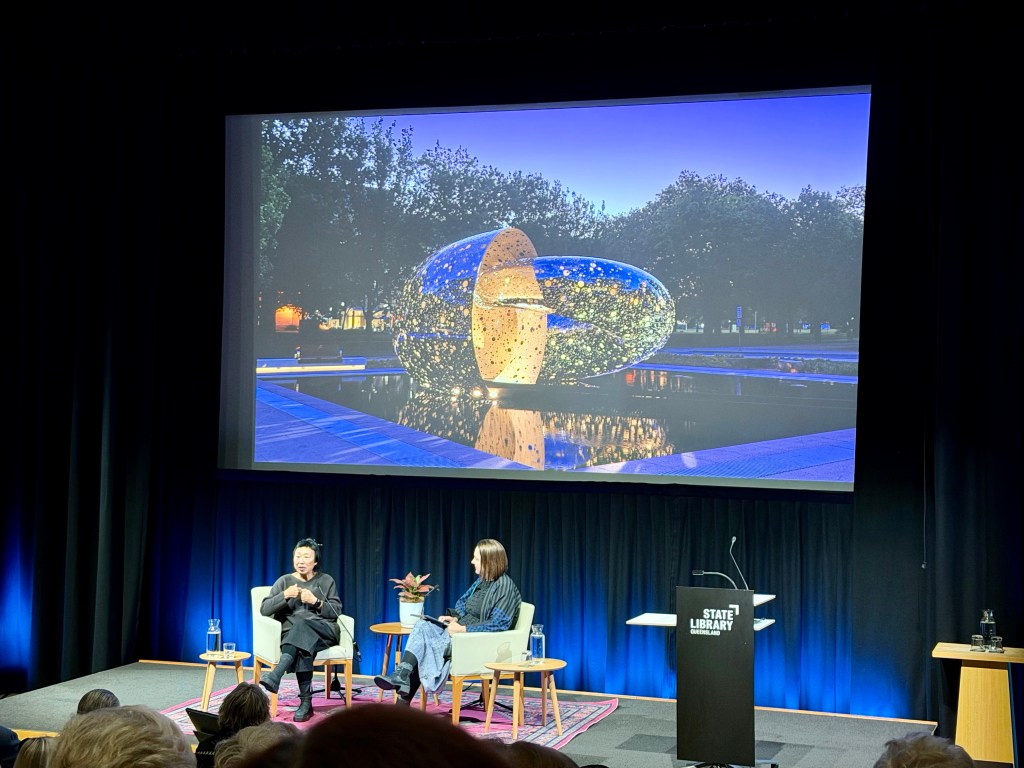
It’s a series of events called Portrait of an Artist and funded by James Sourris who is of Greek descent. His family brought the moving image or picture show to Queensland. He is elderly now but I took the opportunity to thank him for this generous and worthy contribution to recording important Queensland artists.
Lindy Lee was interviewed in what was a lively, funny and informative session about how her family came to Australia, dad in 1946 and then her mother in 1953 ( that’s a long time to be apart ) looking for a better life. She was born here in 1954 and spent years feeling as if she did not belonging to the wider Australian society and yet when she tried to return to China she was even more estranged.
These are not uncommon feelings for a large majority of immigrants and they absolutely resonated with me –
With a practice spanning over 40 years, grounded in her Chinese heritage and shaped by Taoist and Buddhist philosophy, Lee translates these concepts into striking, meditative forms that often engage with light, fire and elemental processes. Her work, drawing on themes of identity, ancestry and cosmology, explores the interconnectedness of all things.
What I loved was her recalling being 9 years old looking at dust mites in the sunshine streaming into the window of their home at Kangaroo Point. This pierced light is a feature of many of her works.
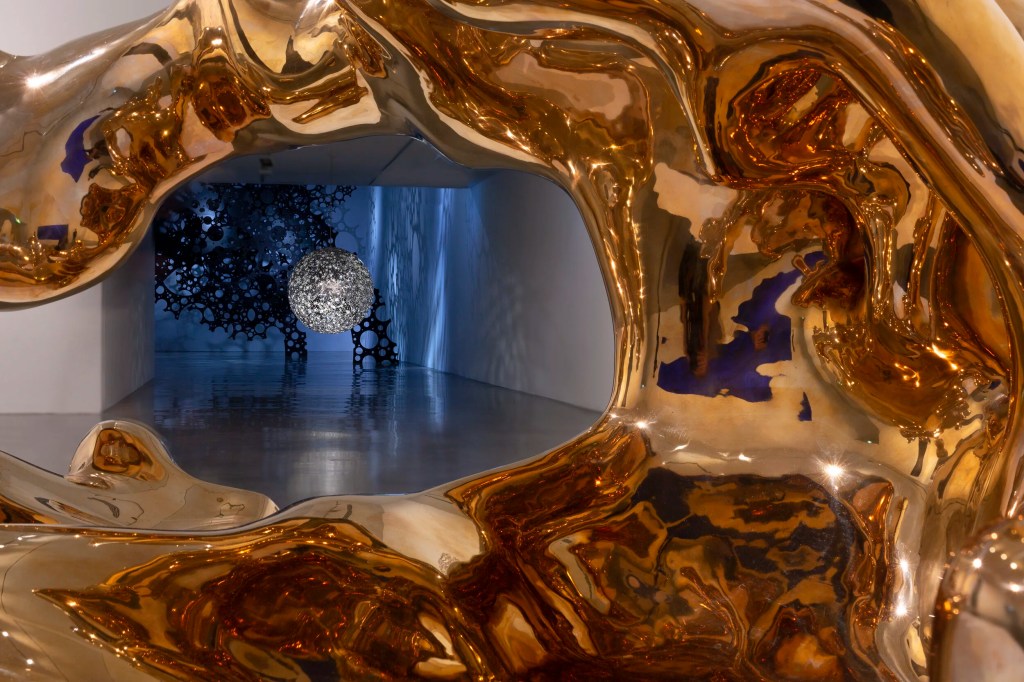
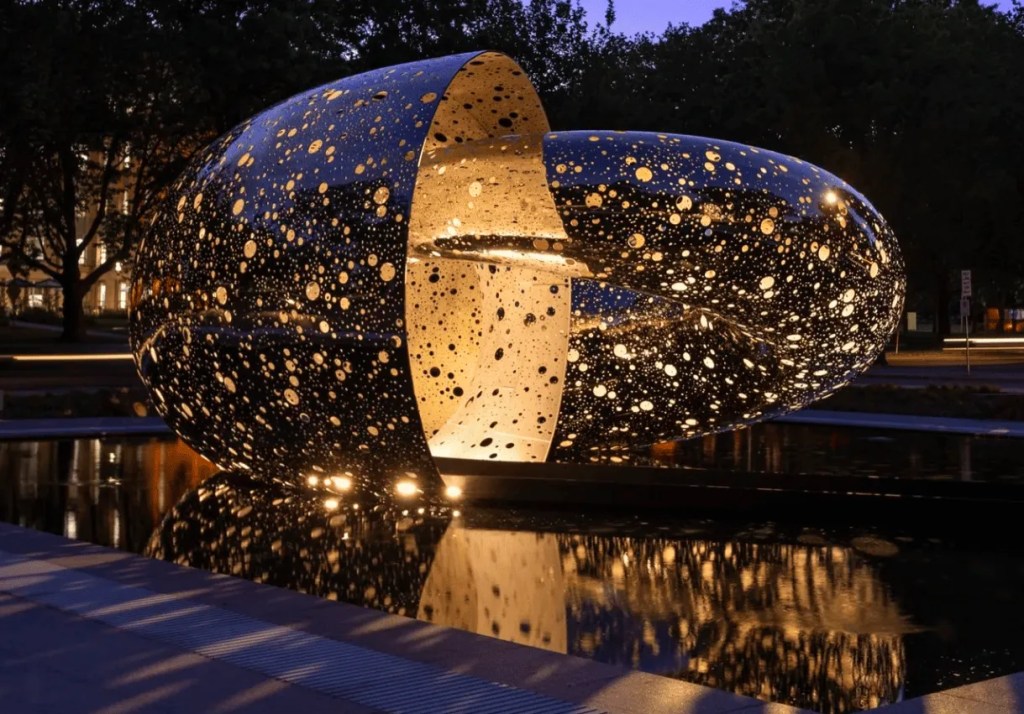
Lee rose to national prominence with Moon in a Dew Drop at the Museum of Contemporary Art Australia in 2020, one of its most visited exhibitions. Her major survey Myriad Stars Between Myriad Worlds is currently touring across China. In 2024, Lee was commissioned by the National Gallery of Australia to produce her most ambitious work to date: the immersive sculpture Ouroboros, a 13-tonne work evocative of a snake eating its own tail, symbolising cycles of birth, death and renewal.
The ancient symbol of the ouroboros (two Greek words ‘tail’ and ‘eating’) is a serpent devouring its own tail and represents the eternal cycle: death and renewal, endings folding back into beginnings, the universe consuming and recreating itself endlessly.The sculpture doesn’t just sit in its location. It absorbs it. Every reflection is different depending on the time of day, the weather, where you’re standing. You are always part of what you’re looking at.
In 2024, she was appointed an Officer of the Order of Australia for her significant contribution to contemporary art and cultural leadership.
She is 72, looks great – and feels she has a lot more to offer. She is reconciled with where she is in the world and how she belongs within it. This is an older interview – but an interesting insight into her thoughts.
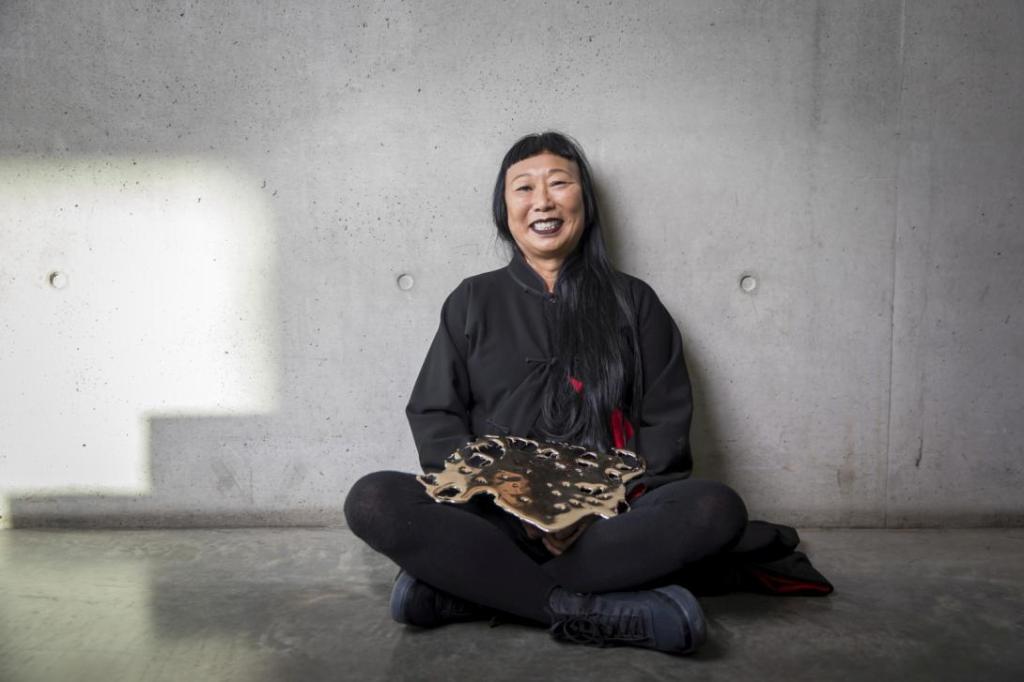
Sullivan+Strumpf, Sydney and Singapore / Photograph: Anna Kucera
It was her answer to the last question that I found so incisive.
What is your view of multiculturalism in Australia today?
I think Australia’s spirit of place is that negotiation between cultures; it is its spirit of place; it is its energy and vitality. Multiculturalism is absolutely a centre.
I also loved this story she retold of her days in school.
“A boy was misbehaving in class. The teacher exclaimed, ‘Johnny, its 12 o’clock! Don’t you know this moment will never happen again! Wake up to yourself. This is your life’. I don’t think Johnny cared, but it made a big impression on me. I looked at the clock and watched the second hand sweep around and realised, That’s true! That was my first conscious recognition of time and a huge epiphany.”
 Mezze Moments
Leave a comment